English
 Español

Industry News
Home / News / Industry News / Round Head Square Neck Carriage Bolts: Specifications, Materials, and Sourcing
Round Head Square Neck Carriage Bolts: Specifications, Materials, and Sourcing
Sep 29, 2026
Content
- 1 What Exactly Is a Round Head Square Neck Carriage Bolt?
- 2 Dimensions and Size Ranges You Can Source
- 3 Materials, Grades and Finishes
- 4 Where Carriage Bolts Earn Their Place
- 5 How to Specify a Carriage Bolt Correctly
- 6 Quality Checks Before Shipment
- 7 Installation Notes Worth Passing On
- 8 Frequently Asked Questions
When a project needs a fastener that can be tightened from one side, refuses to spin, and leaves a smooth dome on the finished face, round head square neck carriage bolts are almost always the answer. They are one of the oldest and most dependable profiles in any fastener catalogue, and they are still a workhorse in construction hardware, timber structures, furniture and general assembly work.
At SINI FASTENER, carriage bolts and round head bolts are among the products we make most often. The notes below cover the anatomy, size ranges, materials, finishes and ordering details that genuinely matter, drawn from what we see every day in production and in export shipments to customers across North America, South America and Europe.
What Exactly Is a Round Head Square Neck Carriage Bolt?
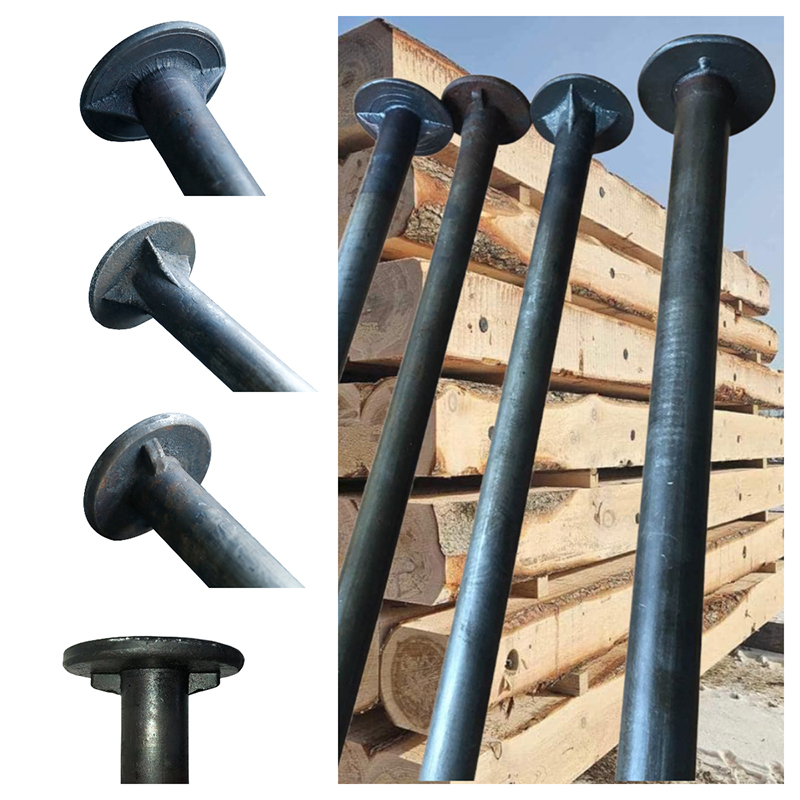
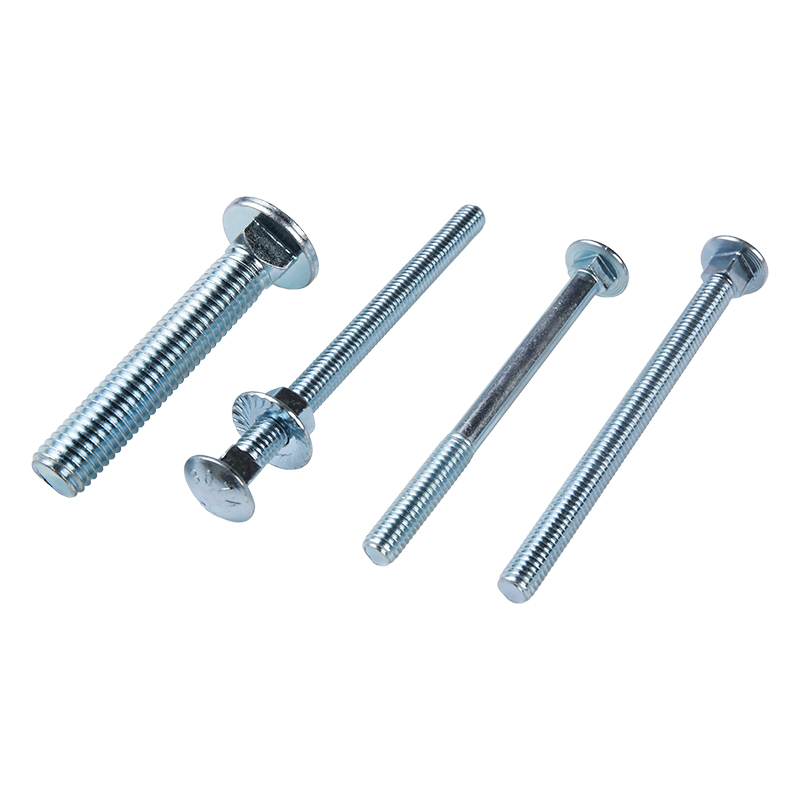
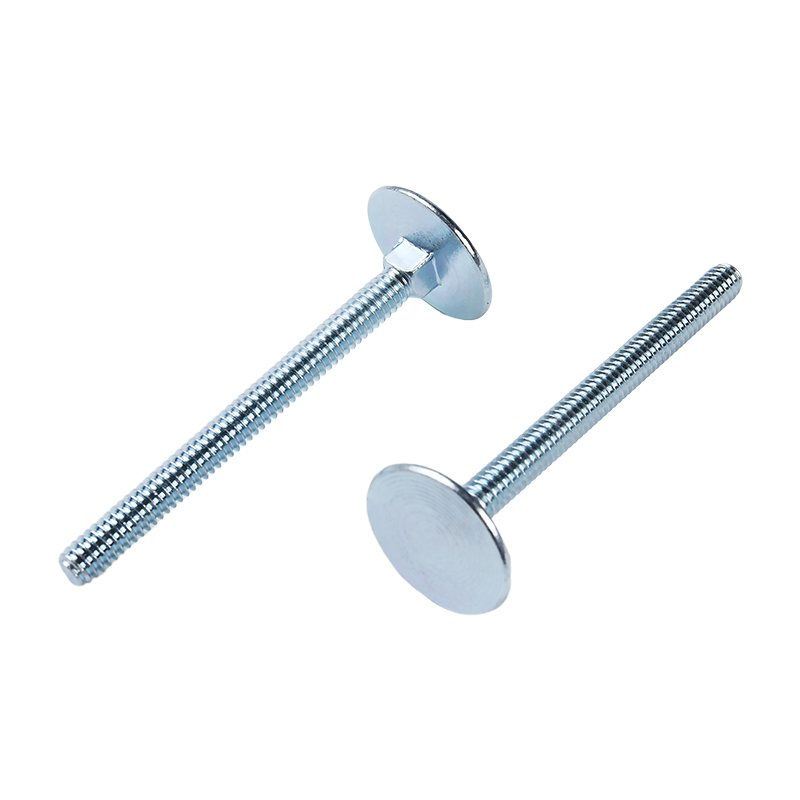
Depending on where you buy, the same fastener may be called a carriage bolt, a coach bolt, a cup head square neck bolt, or a DIN 603 mushroom head square neck bolt. The names vary, but the geometry does not. Four features define the product:
- A domed round head with no driving recess, so it cannot be turned from the top.
- A square neck directly beneath the head that bites into the hole and locks the bolt in place.
- A plain shank that carries the load across the joint.
- A threaded end that accepts a hex nut, and normally a washer as well.
The square neck is the clever part. When the bolt is pulled into a square punched hole, or a round hole drilled slightly undersized, the neck embeds itself in the wood or soft material and prevents rotation. That means a single person can tighten the nut from the other side without holding the head with a tool. It also means the head stays flush and neat, which is why the profile is so common on visible surfaces such as decking, fencing, furniture frames and playground equipment.
Inch-series carriage bolts are generally made to ASME B18.5, while metric versions follow DIN 603. The two standards are not interchangeable: head diameters, neck widths and tolerances differ, so always state which one governs the order.
Dimensions and Size Ranges You Can Source
One point that causes more confusion than any other is length measurement. Carriage bolt length is measured from the underside of the head to the end of the bolt. The head itself is not included, so a 4 inch carriage bolt has a 4 inch shank and thread, and the head sits on top of that.
| Nominal size | Metric equivalent | Square neck (mm) | Head diameter (mm) | Common length range |
|---|---|---|---|---|
| 1/4" | M6 | 6.4 | 15.1 | 1/2" to 6" |
| 5/16" | M8 | 8.0 | 18.3 | 3/4" to 8" |
| 3/8" | M10 | 9.5 | 21.4 | 1" to 10" |
| 1/2" | M12 | 12.7 | 27.8 | 1" to 12" |
| 5/8" | M16 | 15.9 | 34.1 | 1-1/2" to 12" |
| 3/4" | M20 | 19.1 | 40.5 | 2" to 12" |
Metric equivalents in the table are practical cross-references rather than exact substitutions, because the two systems define head and neck dimensions differently. What matters is that both dimension families are readily available. Our bolt production covers diameters from 3/16" to 1-1/2" (5 mm to 52 mm) and lengths from 1/2" to 60" (10 mm to 1500 mm), which means long timber bolts are just as routine for us as small furniture sizes.
Materials, Grades and Finishes
Most carriage bolts are made in carbon steel, with stainless steel used where corrosion resistance is the deciding factor. Plain carbon steel is perfectly adequate indoors, or outdoors when a suitable protective finish is applied.
- Low carbon steel, roughly Grade 2 or property class 4.6, for general light-duty fastening.
- Medium carbon steel, roughly Grade 5 or class 8.8, for structural and higher-load joints.
- Alloy steel, roughly Grade 8 or class 10.9, for demanding mechanical applications.
- Stainless steel 304 (A2) for general exterior and mildly corrosive environments.
- Stainless steel 316 (A4) for marine, coastal and chemical exposure.
Finishes follow the same logic. Clear or yellow zinc plating gives a clean appearance and moderate protection. Hot-dip galvanizing builds a much thicker zinc layer and is the usual choice for outdoor timber construction. Black oxide suits decorative or indoor assemblies, and plain oiled finishes are used where the part will be painted or plated downstream.
One practical warning we pass on to every customer: modern pressure-treated lumber is chemically aggressive. Copper-based preservatives attack ordinary zinc plating quickly, so fasteners used in treated timber should be hot-dip galvanized or stainless, not simply zinc plated. This single choice prevents most of the corrosion complaints we hear about.
Where Carriage Bolts Earn Their Place
The domed head and locking neck make this profile well suited to a specific set of jobs, and our customer base reflects that naturally. Construction hardware remains the largest area, covering decks, pergolas, fencing, timber framing and general building assembly. Furniture makers use them for bed frames, table bases and knock-down designs where the head stays visible and tidy. Machinery and machine tool builders use them for guards, panels and covers that must not loosen under vibration, while electrical appliance and equipment manufacturers use them as a neat, tamper-resistant fixing on housings and cabinets.
Outside those industries, docks, marinas, agricultural equipment and playground structures are common applications. In marine settings the combination of 316 stainless steel and a snug square neck gives a fastener that resists both corrosion and loosening.
How to Specify a Carriage Bolt Correctly
Step one: determine grip length
Add up the total thickness of the materials being joined, then add allowance for a washer and a fully engaged nut. Ordering by grip length rather than by guesswork avoids the two most common complaints: a bolt that is too short to engage the nut properly, or one so long that it has to be cut.
Step two: confirm the standard and thread
Decide whether the project is governed by ASME B18.5 or DIN 603, and confirm the thread form. Inch series usually use UNC or UNF threads, while metric series use coarse pitch. Mixing standards in one assembly is a frequent source of fit problems.
Step three: match the neck to the hole
The square neck must sit in a hole that is square or slightly undersized in round material. If the hole is too large, the neck will not bite and the bolt will spin during tightening.
Step four: consider custom production
Standard sizes cover most needs, but non-standard head diameters, special lengths, specific coatings and customer-specific designs can all be produced to drawing. Our facilities in Haiyan, Zhejiang and Lianyungang, Jiangsu handle both standard DIN and IFI production and fully custom work.
Quality Checks Before Shipment
Because carriage bolts often go into structures that must last for years, inspection matters as much as specification. SINI FASTENER operates under ISO 9001 and maintains a dedicated quality control laboratory. Dimensional checks are carried out with video measuring systems, material composition is verified with an optical emission spectrometer, and mechanical performance is confirmed with a universal testing machine, a tensile testing machine and hardness testers. Salt spray chambers are used to verify coating performance and metallographic microscopes to examine structure where required.
The purpose is straightforward: every batch should meet the customer's expectations for strength, durability and reliability, and documentation should back that up. If a project requires test reports or specific inspection criteria, mention it at the quotation stage rather than at shipment.
Installation Notes Worth Passing On
- Drill or punch the hole to match the neck size, keeping it square or slightly undersized.
- Insert the bolt and tap the head firmly so the square neck seats into the material.
- Fit the washer and nut, then tighten with a wrench while the neck holds the bolt steady.
- Avoid over-tightening into soft timber, which crushes fibres and loosens the joint over time.
Following these four steps is usually enough to keep a carriage bolt assembly tight for the life of the structure.
Frequently Asked Questions
Are carriage bolts the same as round head square neck bolts?
Yes. Carriage bolt, coach bolt and round head square neck bolt describe the same profile: a domed head, a square neck and a threaded end.
Can carriage bolts be used in metal?
They can, but the mating part usually needs a square punched hole or a square-hole washer plate, because a round hole in metal will not let the neck bite.
Do carriage bolts come in stainless steel?
Yes, and stainless is the right choice for coastal, marine or chemically exposed installations. For treated timber, hot-dip galvanized steel is the practical alternative.
Round head square neck carriage bolts have stayed in demand for well over a century because the design solves a real problem simply: one person, one wrench, one secure joint, and a finished surface that looks intentional. Get the standard, the grip length and the finish right, and the rest of the assembly tends to take care of itself.
If you are working through a specification and want help matching sizes, materials or coatings, our team is glad to review drawings and confirm what can be produced. It is the kind of question we answer every day, and it is usually quicker than sorting it out after the order has shipped.